

From Learning Completion to Workforce Readiness: Closing Life Sciences' Deployment Confidence Gap
Life Sciences organizations can show exactly what their people have completed. Almost none can show who is actually ready to deploy. Here's why that gap persists, and what it takes to close it.
.jpg)
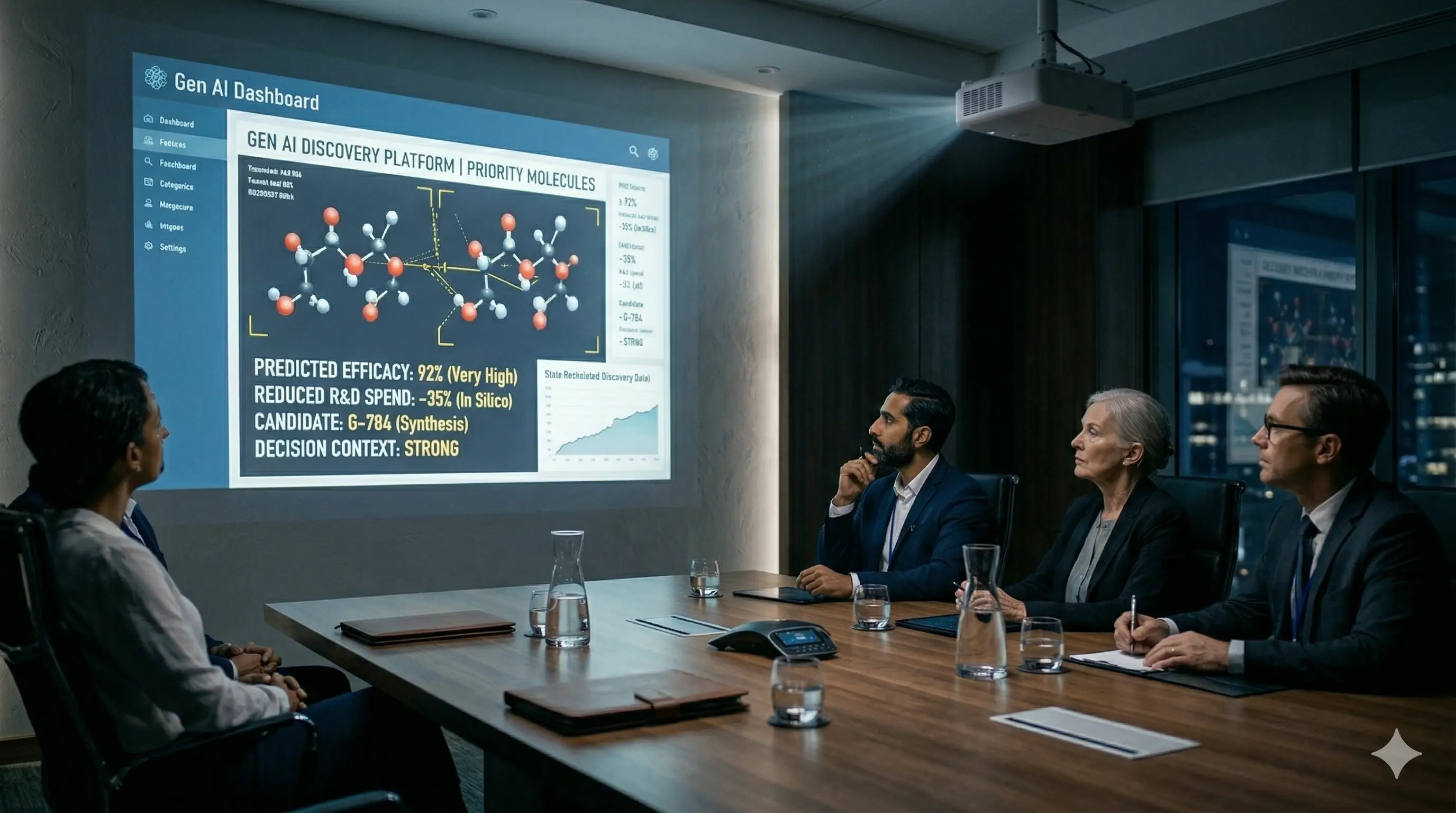
A capability leader at a mid-size pharma pulls up the AI upskilling dashboard ahead of a staffing call. Completion rates are strong across the board. Certificates have been issued. The numbers look like a program working exactly as designed.
Then a delivery lead asks a different question: which three of these people can be staffed onto a live client engagement next Monday, and which one is still six weeks out? The dashboard has no answer. It was built to show who finished, not who's ready.
That gap - between what a learning system can report and what a staffing decision actually needs - is not a reporting problem. It's a capability architecture problem, and it shows up everywhere Life Sciences organizations are trying to move fast on AI.
What Workforce Readiness Actually Requires
Readiness is not a single measurement. It's several distinct claims that all have to hold true at once: that a person has the underlying technical or AI knowledge; that they understand the Life Sciences domain context well enough to apply it responsibly; that they can operate that knowledge inside a specific role, not just in the abstract; that they can perform under something resembling real project conditions; and that someone with authority over the decision — a manager, a delivery lead — has actually validated the claim rather than inferred it from a transcript.
Most organizations measure the first of these reasonably well. The other four are where the architecture breaks down. A learner can finish every module in a curriculum and still be an open question on all four remaining dimensions, and nothing in a standard completion report is built to say so.
Five Gaps Between Learning Completion and Workforce Readiness
Completion is treated as a proxy for capability. A finished course tells you someone was present for the material. It says nothing about whether they can apply it under real conditions, with real stakes - which is precisely the distinction a staffing decision depends on.
Domain context and technical skill are developed separately. AI literacy programs teach AI. Domain programs teach Life Sciences. Rarely does either teach a learner to hold both at once, which is the actual job - a data scientist who understands a model but not the regulatory or clinical context it operates in is not yet deployable, whatever the completion record shows.
Assessment is disconnected from application. A quiz score measures recall in a low-stakes moment. It doesn't test whether someone can reason through an ambiguous client problem, communicate a recommendation, or hold up under the kind of scrutiny a real engagement produces.
Managers have no readiness evidence to act on. The person best positioned to judge deployability - a direct manager who has seen the work - is typically left out of the assessment architecture entirely, or is asked to sign off on a summary they had no hand in generating.
There is no shared readiness language betweenL&D and delivery. L&D reports on programs completed. Delivery makes staffing decisions on gut instinct and informal reputation. The two functions are answering different questions with different vocabularies, which means investment in one rarely shows up as confidence in the other.
Why AI Doesn't Mean Removing People From the Judgment
The instinct with any AI-driven capability system is to assume it means fewer humans making fewer calls. That's not the right shape of the solution, and it's not what actually earns trust from a manager who's being asked to stake a client engagement on the output. The right role for AI is to make the evidence available faster and more consistently - while the decision itself stays with the people who own it. A connected capability architecture works across several dependent layers:
Structuring enterprise knowledge turns what already exists in documents, SME expertise, and prior project work into something a learner can actually draw on, rather than knowledge that stays locked in one person's head until they leave.
Baselining each learner accurately means starting from where someone actually is - through self-reflection, a diagnostic, and the people around them - rather than assuming everyone in a cohort needs the same content in the same order.
Orchestrating a pathway around the gap, not the curriculum personalizes development toward the specific capability a learner is missing, instead of pushing a generic sequence at everyone regardless of where they started.
Evaluating applied performance, not just recall, means assessment happens through something closer to real conditions - a project, a capstone, a scenario - rather than a multiple-choice checkpoint.
Surfacing evidence a manager can actually use turns the output of all of the above into something specific enough to inform a staffing call, rather than a completion percentage that answers a different question entirely.
Throughout, the manager, the SME, and the delivery lead stay the ones who decide. AI accelerates the evidence gathering; it doesn't replace the judgment call at the end of it.
Why This Shift Is Gaining Ground in Life Sciences Specifically
The upskilling investment is already large and still growing. Lifesciences companies are increasing AI and digital upskilling investment at a fast clip - a trend Clarkston Consulting's 2026 industry research puts at 69%of companies planning increased investment, up 51% since 2023, with 94% of leaders calling AI crucial to scaling operations. That level of spend raises the cost of not being able to show what it produced.
The verification gap shows up in the hiring literature too, which makes it harder to dismiss. Harvard's Project on Workforce, in research conducted with the Burning Glass Institute, found that fewer than 1 in 700actual hires reflected employers' stated skills-based hiring policies. Separately, TestGorilla's 2025 State of Skills-Based Hiring report found that85% of employers now say they use skills-based hiring- astated-policy-versus-practice gap that mirrors what happens inside internal upskilling programs as well. A related National University analysis of 2026hiring data found that 53% of employers cite verifying skill claims as their main obstacle to acting on skills-based policy.
Named programs at real scale show the investment is not hypothetical. Sanofi's public commitment to upskilling more than 16,000 employees and Pfizer's Impact Report describing over 33,000 colleaguesin personalized growth journeys both show this isn't a future problem - it's a current one, at a scale where “did it work” is already a fair question to ask.
Domain-specific roles make the stakes higher than in most industries. A technically capable person who lacks Life Sciences context isn't a minor gap to manage around - the cost of an unready professional in front of a client or a physician is a different order of risk than in most sectors that use generic upskilling platforms.
How These Layers Actually Fit Together
None of the pieces above works in isolation, and treating them as separable is where most capability programs quietly fail. A knowledge repository without orchestration is just a searchable archive - useful, but inert. A learning pathway without applied assessment produces people who can discuss a topic but haven't been tested against it. An assessment without a route back to the manager who needs the answer produces a score nobody outside L&D ever sees. And a certification issued without ongoing evidence behind it is a credential resting on a single point-in-time judgment, not a live signal of current capability.
The value only shows up when these operate as one continuous chain: enterprise knowledge feeds a personalized pathway, the pathway feeds applied assessment, assessment feeds a validated readiness signal, and that signal reaches the person making the staffing decision in a form they can actually use. Break the chain anywhere and the organization is back to reporting completion instead of readiness.
Bringing It All Together: From Learning Activity to Workforce Readiness
The commercial analytics lead who prompted this piece, and the delivery lead asking who's actually deployable next Monday, are both describing the same organization from two different vantage points. One sees a dashboard full of completions. The other needs a specific, defensible answer about a specific person. Right now, most Life Sciences organisations have built the first system well and left the second one unanswered.
Alexandria AI is Agilisium's Life Sciences Capability Intelligence Platform - connecting enterprise knowledge, learning, applied capability and readiness evidence so organisations can make deployment decisions with confidence.
This challenge first became tangible inside Agilisium as we developed our own technical consultants into Forward Deployed Experts capable of operating at the intersection of AI, Life Sciences domain knowledge, and client delivery - proof the architecture works before it was ever offered outward.
Alexandria connects that knowledge, learning, applied assessment, and manager validation into one continuous system, rather than leaving each as a separate initiative that L&D and delivery interpret differently - moving an organization from knowledge to learning to demonstrated capability to readiness, and producing a Go/No-Go verdict grounded in evidence rather than a completion percentage standing in for one. For CHROs and capability leaders, that means visibility into where capability actually exists and where it doesn't. For delivery and business leaders, it means a defensible,evidence-backed answer to who is domain-ready, role-ready, and project-readyfor a specific engagement - before the staffing call, not during it.
Explore how Alexandria AI can help your organization move from tracking learning activity to validating workforce readiness.
.jpg)
.webp)
.webp)
.webp)
.webp)
.webp)
.webp)











%20(7).avif)























%20(5).avif)
.avif)


