

The AI-Era Professional Isn't a Coder or a Domain Expert. They're Both at Once.
Life Sciences talent needs AI fluency and domain expertise to work together. See how Alexandria AI helps build and validate that combined capability.
.jpg)
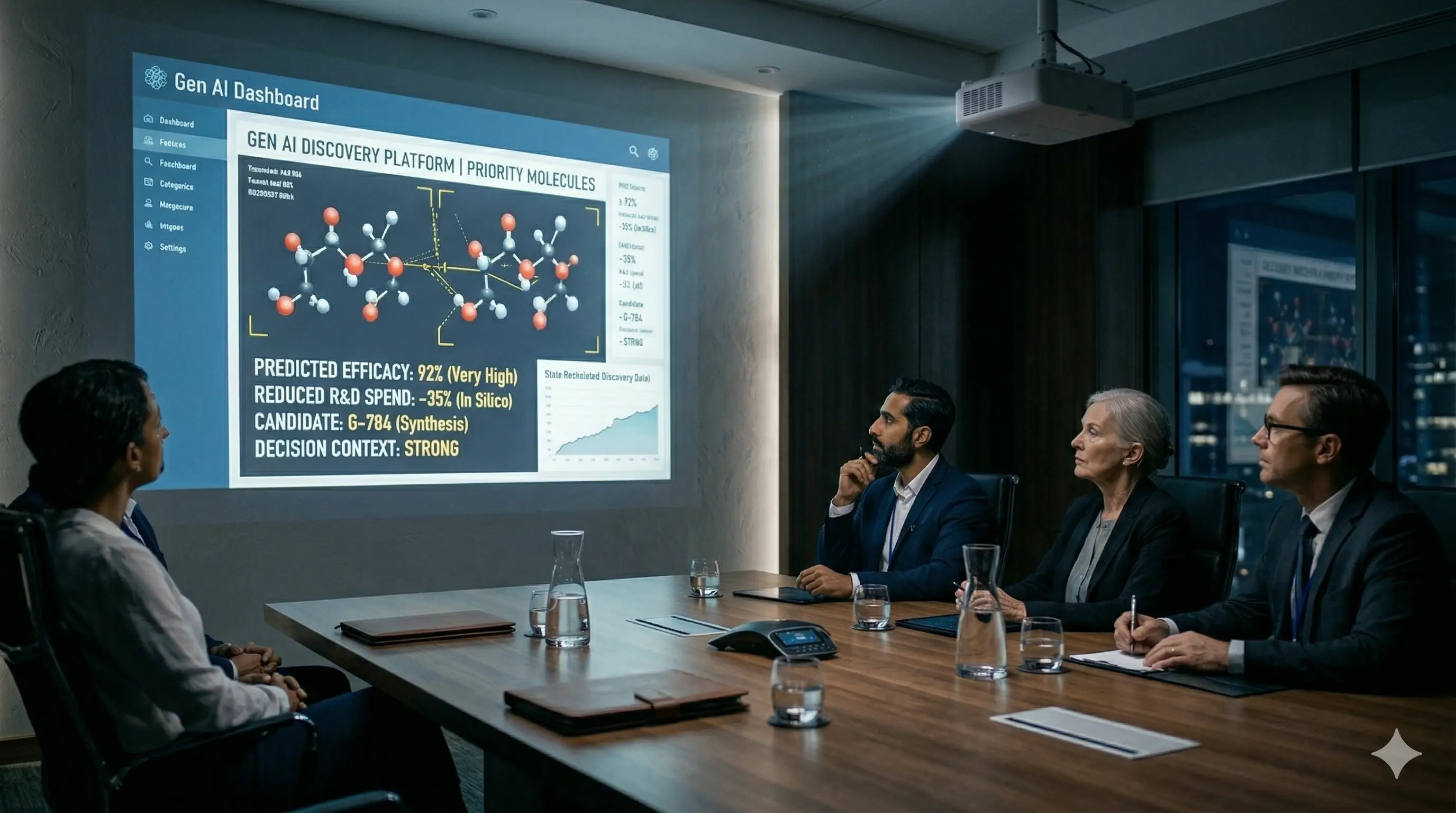
During a quarterly business review, a market access manager clicks to a slide her team built with an AI tool's help. A payer strategist across the table, twenty years into the job, asks a simple question: why did the model group these two markets together? She doesn't know. The recommendation looked reasonable, so the team trusted it and moved on. Nobody in the room did anything wrong, exactly. The meeting continues.
The problem can appear quietly across Life Sciences teams: AI is no longer a tool people reach for on the side of their work. It sits inside the decision itself, and that changes what it means to be good at a job. For years, domain expertise and technical capability could develop on separate tracks and still meet in the middle often enough. In a function where a wrong assumption can affect a launch timeline, a regulatory filing, or a patient outcome, that margin has largely disappeared.
Why Knowing the Tool Isn't the Same as Knowing the Job
An employee can complete an AI fundamentals course and still not know how to use it inside a real Life Sciences workflow: which output to trust, which to challenge, and how a recommendation should change a decision where getting it wrong actually matters. Knowing the tool and knowing the job are different capabilities, and a training completion record only ever shows one of them.
The reverse gap is just as common, and just as easy to miss. A market access manager with a decade of payer relationships doesn't automatically know how to interrogate a model's output or notice when a pattern it surfaced doesn't hold in the real market. Domain depth alone doesn't teach anyone to question a machine. The issue isn't a missing course on either side. It's that these two kinds of understanding are still built on tracks that were never designed to meet inside the same piece of work.
The Professional the AI Era Actually Requires
The professional this moment calls for isn't a data scientist who picked up some pharma vocabulary, and it isn't a domain veteran who sat through a weekend AI workshop. It's someone who can hold domain judgment, AI fluency, and business context together at the exact moment a call has to be made, rather than splitting that judgment across three people in three separate meetings.
Think of it as a convergence rather than a checklist: domain judgment, AI fluency, and business context, applied together, in the same moment of work. None of the three is optional, and none substitutes for the other two. A regulatory writer doesn't need to build models. A data scientist doesn't need a clinical background. What both need is enough fluency in the other's territory that judgment and technical output can sit in the same conversation, instead of passing between two people who each hold half the picture.
That's also why the value here doesn't come from stacking more capability onto an individual profile. It comes from where the three capabilities meet, at the point a real decision gets made.
Why Separate Capability Tracks Keep Failing
The deeper problem isn't that companies run separate AI courses and domain courses. It's how capability gets built in the first place. In most organizations, AI capability is developed by one team, domain expertise by another, role competencies by a third, and staffing or deployment decisions get made somewhere else entirely, often without visibility into any of the other three.
Each group is doing reasonable work. But the employee is the only place all of it is supposed to come together, and nobody owns making sure that actually happens. The market access manager from the opening scene didn't lack an AI course or a payer strategy course. She lacked a way to develop and demonstrate both capabilities at once, inside the kind of decision she was actually being asked to make.
Fixing that takes more than another training track. It takes a single view of what a person can already do, what a specific role actually requires, where the real gap sits, and whether the person can demonstrate the combined capability under real conditions, not just describe having taken a course.
How Alexandria Builds the Combined Capability
This is the problem Alexandria AI, Agilisium's capability platform for Life Sciences, is built around. Alexandria runs on a CORE model: Capture the expertise that makes an organization's own people effective, Orchestrate learning around what a specific role and person actually need, Ready people through real-world application rather than course completion, and Enable that readiness to be visible across the business.
In Curriculum Studio, an organization's own SMEs and institutional judgment become a structured blueprint, not a generic AI-101 track handed to everyone. The Content Generation Agent turns that blueprint into learning material, and Learner Studio shapes it into an adaptive pathway suited to the person's starting point and role, rather than the same fixed sequence for a regulatory affairs associate and a commercial analyst.
Development doesn't stop at the module. Each pathway ends in a capstone-verified certification: a real-work project a person has to complete, not a quiz to pass. Manage Studio gives managers visibility into how that capability is actually progressing, so a readiness call is based on demonstrated work, not a completion log.
One Role, One Convergence: A Commercial Analyst's Path
Consider a commercial analyst two years into the role. Her starting profile is strong on descriptive analytics and reporting, but the role ahead requires more: using AI-generated models to surface prescribing or market patterns, then judging which are commercially meaningful versus statistically present but practically irrelevant.
The gap isn't a missing AI course. It's the specific judgment of knowing when a model's output should change a commercial recommendation and when it shouldn't. Her development is shaped around that gap: an adaptive pathway in Learner Studio built from real scenarios in her own therapeutic area, not generic AI training.
She works through a capstone built around an actual market question, defending which patterns she'd act on and why. Her manager reviews that reasoning in Manage Studio and validates whether her judgment holds up under the kind of pushback she'd get in a real strategy review.
What comes out the other side isn't a training certificate. It's evidence she can bring AI fluency, domain judgment, and business context together on a live question.
Why Generic AI Fluency Doesn't Travel Well in Life Sciences
In Life Sciences, domain context isn't texture around the work. It is the work. A market access professional has to challenge an AI-generated payer segmentation against real contracting dynamics, not just accept the cleanest-looking cluster. A clinical operations professional has to interpret an AI-supported insight inside protocol and operational constraints a general-purpose model has no way of knowing. A regulatory professional has to apply AI without losing the evidence discipline and traceability a submission depends on.
The convergence looks different by function: in market access it shows up in how a segmentation gets interpreted; in clinical operations, in how an insight gets weighed against protocol; in regulatory, in how traceability gets preserved. There is no single, universal version of “AI readiness” in Life Sciences. The capability only becomes meaningful once it's tied to a specific role, domain, and decision context, which is exactly why generic AI fluency, taught the same way to everyone, tends to fail where the stakes are highest.
Forward Deployed Experts: The Professional This Adds Up To
If capability convergence describes what the AI-era professional needs, the Forward Deployed Expert is Agilisium's expression of what that professional looks like in practice. FDX stands for Forward Deployed Expert: someone who brings domain judgment, AI fluency, and business context together in the context of real work.
That profile is organized around six areas: AI Literacy, Domain Literacy, Communication, Problem Solving, Outcome Orientation, and Business Acumen. Alexandria is the capability intelligence environment built to help develop and validate that profile, in the context of the work a person actually does.
What This Means for Leaders Making Deployment Calls
For leaders, the stakes go beyond the individual learning experience. When AI capability and domain capability keep developing on separate tracks, technology adoption tends to move faster than professional judgment can keep pace with. Role readiness becomes hard to evaluate with any confidence, and staffing decisions stay subjective, made on tenure or instinct rather than demonstrated capability.
Capability gaps often become visible only after someone is deployed into a role, a costly point at which to discover them. Investment in AI tools doesn't automatically turn into workforce capability. It requires a deliberate way to see who can apply AI responsibly and effectively in a specific Life Sciences context, and who isn't there yet.
Go back to that quarterly business review. The gap in the room wasn't a missing AI skill, and it wasn't a missing domain skill. It was the absence of someone who had developed both together, and no system in place to make that convergence visible before the meeting started.
.jpg)
.jpg)
.jpg)
.webp)
.webp)
.webp)
.webp)
.webp)
.webp)











%20(7).avif)























%20(5).avif)
.avif)


