Reimagining Enterprise Transformation with AI-Driven Workflows
In This Episode
In this episode of the Life Sciences DNA Podcast, Bijoy Sagar, Chief Digital & Information Officer at Bayer, joins Nagaraja Srivatsan to discuss what it takes to build an AI-led enterprise. He shares how organizations can move beyond technology experimentation to reimagine workflows, drive innovation at scale, and create meaningful business outcomes through AI.
From Processes to AI-Driven Workflows
Bijoy explains why organizations must move beyond siloed processes and redesign end-to-end workflows with AI at the center to achieve scalable transformation.
Solving Business Problems Before Deploying AI
Learn how Bayer's innovation framework focuses on defining the right business problem first, ensuring AI investments are aligned with measurable outcomes.
Building an Innovation Culture at Scale
The conversation explores how co-creation, experimentation, and empowered teams are helping Bayer accelerate AI adoption while fostering a culture of innovation.
Data as the Foundation for AI Success
Discover how Bayer is breaking down data silos, creating accessible data ecosystems, and leveraging AI-driven ontology development to improve decision-making.
Preparing the Workforce for an AI Future
Bijoy shares his perspective on change management, continuous learning, and the skills needed for employees and leaders to thrive in an AI-enabled world.
Transcript
Daniel Levine (00:00):
The Life Sciences DNA podcast is sponsored by AgilisiumLabs, a collaborative space where Agilisium works with its clients toco-develop and incubate POCs, products, and solutions. To learn how AgilesiumLabs can use the power of its generative AI for life sciences analytics, visitthem at labs.agilisium.com. Sri, we've got Bijoy Sagar on the show. Who isBijoy?
Nagaraja Srivatsan (00:30):
Bijoy Sager is Bayer's chief digital and informationofficer. He's been leading a lot of their transformation around AI, datainfrastructure, and digital strategies across both pharma and crop sciences.
Daniel Levine (00:42):
And for people who may not follow Bayer closely, whatshould they know about Bayer?
Nagaraja Srivatsan (00:47):
Bayer is one of the largest life sciences companies in theworld, spanning pharmaceuticals, consumer health, and agriculture. So when theymake moves in AI, it's not theoretical. It affects drug development pipelines,clinical trials, and even global food supply systems.
Daniel Levine (01:02):
And what are you hoping to hear from him today?
Nagaraja Srivatsan (01:04):
Bijoy is a practitioner. Over the last three decades, he'sbeen part of several digital transformations and industry transformations. He'sleading AI initiatives at Bayer and really coming out with a framework on howdo you drive innovation at scale, but operationalizing that to make sure thatit makes meaningful impact on outcomes. So really looking to have a very gooddialogue around how do you start going down the AI journey in a largeorganization like Bayer, and how do you then come out with the right kind ofoperating infrastructure to make AI successful?
Daniel Levine (01:42):
Well, before we begin, I want to remind our audience thatthey can stay up in the latest episodes of Life Sciences DNA by hitting thesubscribe button. If you enjoy the content, be sure to hit the like button andlet us know your thoughts in the comments section. And don't forget to listento us on the go by downloading an audio-only version of the show from yourpreferred podcast platforms. With that, let's welcome Bijoy to the show.
Nagaraja Srivatsan (02:09):
Bijay, it's so great to have you here on the show. Really,thank you for taking the time.
Bijoy Sagar (02:15):
Great to be here. Thank you, Sri.
Nagaraja Srivatsan (02:17):
Yeah. Bijoy, maybe I'll give you a little bit of abackground in two parts. Maybe you could talk about your wonderful journey 30plus years in the marketplace, but how you transformed yourself as a techleader. Maybe a quick intro that and then your role at Bayer and how you'redriving a transformation there.
Bijoy Sagar (02:36):
So mine is an accidental journey. It was not necessarily aplanned journey, which I think helps in some ways. I started my career inresearch and spent some time in development. Ended up in sales and marketingfor some time, and then arrived in IT through strategy. So I have sort of donethe value chain and I arrived into the tech function just as it was becomingreally more important, if you think about it, for the way these domains areworking. So if you go back to 30 years ago, tech was not central to thebusiness, especially in life science. And it was sort of a necessary evil thathappened in the background. And as long as everything worked, I mean, everybodywas happy. So my journey has been, to some degree, being able to see how theprocesses worked in the value chain in life science, and then able to map thetech to that.
(03:54):
And if you think about it, Srivatsan, and you've gonethrough it yourself, we've gone through at least now three separate cycles: sothe world where we sort of led that outsourcing and scale up; and looking atdefining what is the role of tech in a company like this, what's essential,what is not essential to the digital transformation, how to put tech in thecore of the digital process in the company; and now the AI transformation. AndI don't think these are as separate as people would say it is, but they'reliterally a wedding cake where one could not have been possible really withoutthe others. So I think I've been very lucky to have been around through thesetransformations. And to some degree, this is, I think, the most important oneof those because the pharma playbook on how we find the right candidates, howwe scale them, how we go to market, it hasn't changed in some time.
(05:10):
We've been talking about it, but it really hasn't. Andwhat AI is really helping us is to reimagine what that could mean. And this isvery timely given how unmet diseases are looked at, how pharma pricing is goingto be and is already very important to the governments and the users. And Ithink used wisely, AI has a role to play in all of this: finding cures for newdisease conditions, unmet needs, doing it the right way, and scaling it acrossmultiple populations. So yeah, that's sort of my journey in a nutshell.
Nagaraja Srivatsan (05:58):
No, it's fantastic. As you said, the journey itselfprepared you for the future. And I've been reading some of your key views andyou've been very poignant in saying that AI is a tool, not a magic. And reallyyou had articulated that you need to solve clear business problems and nottechnology looking for use case. And so I want to start with that theme becauseI think that's so poignant for what market is today. It's not a hammer chasinga nail and you've been very practical about it. So walk me through what are theclear business problems you're attacking as a leader right now, and then howare you making this thing practical?
Bijoy Sagar (06:34):
We are coming to a point where we are thinking, what doesan AI-led enterprise mean? Because people use these terms. What does thatactually mean? And to some degree, what that means is you have to reimagine theworkflows with AI as the primary mediator, if you will, and then look at how doyou really create scale with it? So it's not, "Hey, I have inefficientprocesses today. I have siloed organizations. I have all of these walls I havebuilt. Let's throw AI on top of it and things would work." So clearly it'snot that. So it also is not, "I have a cool technology here, what do I dowith it? " So it's not enough to say there is a business problem. You haveto really define the business problem at the right level. So one of the thingsthat we are encouraging in the company now quite at scale is, "Hey, bringyour problems into our innovation center.
(07:44):
Let's spend a week talking about what that problem is andwhy is it a problem. Let's spend some time talking about what solution couldsolve that problem fundamentally, and then let's go experiment with thatsolution really fast with AI first." So it's as much, it's about the howas it is about the what, not so much about the tech itself, because I thinktech is part of the solution. At least that's how we are thinking about itcarefully.
Nagaraja Srivatsan (08:20):
And that goes back to your past experience, right?Transformation doesn't happen when you just put a lipstick on a pig or you putthe rubber band on this one, like as you said, siloed processes, siloedorganizations, and then start to solve it, you have to fundamentally solve. Butwith that said, as you are going into those innovation workshops, are yougetting incremental use cases, big bang use cases? I saw you had a frameworkabout a three-step framework about one has changed the business, then the incrementaloperational process, then also doing things in and around your tech stack. Butwalk me through, if I'm outside, how do I bring a use case to you and how doesthat work?
Bijoy Sagar (09:03):
So we have, I would say, a top down and bottom-upframework. The top down is we as a company are very aligned on what are the biggoals we want and how we are going to transform. I can't talk about itobviously too much because it's really internal, but I think this is really thecore binding strategy. We know what are we going after, we know what we are notgoing after, and we have a framework, and we have defined a structured framearound that. So who is accountable for the pieces of that framework, what isthe role of the border management, what is the role of tech organization,what's the role of each business function? That I think is the top downconstraining factor. The bottom-up constraining factor is, "Hey, you havean idea, you have a problem." I don't believe the time has come for us tosay, "No, no, no, it's all going to be centrally mediated." I'm like,"You come together and let's solve it."
(10:14):
So we built internally what is called an agent builderframework, and that framework is now built into an agentic platform so thateverybody in the company follows the same agent builder methodology and themethodology is tied to how you do it technically. So you can come into ourcenter in Warsaw or Berlin or Bangalore and you'll walk out with a similarprocess because I want people to get comfortable with this way of working. Solast week we had one of our largest enabling function leaders that went throughthat in Warsaw. We had one that happened in Bangalore just a couple of weeksbefore that. On the 11th, we are actually bringing some external leadersoutside the company into a hackathon in the same process because we want tounderstand what is a customer pain point.
(11:19):
So that's sort of the methodology. Now, what'sconstraining all of this is the tech stack. So where there is no value inconsolidating the tech stack, we have freedom, but as you go deeper into thestack, you have fewer elements of freedom because ... Yeah, exactly.That's howwe have built it. And we are mediating it through these hubs, digital hubs. Andthose hubs are carefully placed in three parts of the world so that you canactually bring the right talents and they're closer enough to the business thatyou want business to be there to co-create. So no throw over the fence methodanywhere. Nobody gets to say, "Go build X and then throw it over the fenceYou need to come, we need to co-create, we build it. "
Nagaraja Srivatsan (12:17):
That's a really useful idea because I've been seeing thesuccess of many of the platforms is exactly that business sponsorship to doingthat. Now you said you brought this enabling function together. Are they bigticket items like I'm HR and I want to transform the recruitment process or isit like, okay, let me do my payroll processing in a much more ... Is it a $1 inthe effort, $10 effect, $1,000--I'm going to say one dimensionally.
Bijoy Sagar (12:43):
These are big, big, meaningful cases. If it is really that$1 effect, that's where having that first day of conversation opens a frame.Now, I will not say that the $1 questions never happen anywhere. It's a largecompany, things like that happen, but it's mostly you show up with that, let'shave a dialogue. How do you sort of take that $1 thing, expand so you can seethe $1,000 story. So in pharma, the one in Bangalore that I just alluded to, Isaw these two cases we wanted to scale, but the big sort of learning for me wasthere were essentially two parts of the same coin. So I'm like, let's bring ittogether because it's not solving ... It looks like it's solving two differentthings, but I think they are going to be building a platform. It's a nascent partof the platform.
(13:50):
So that happens as well quite a bit.
Nagaraja Srivatsan (13:52):
Bijoy, are you seeing a lot as you look at the pharmacontinuum mode and drug discovery stage, because I know you're fundamentallyinvesting in getting new molecules and target identification. Are you seeingmore in clinical development or commercial or you're seeing a smorgasbord ofuse cases across the board?
Bijoy Sagar (14:09):
We see all three, but the opportunities are verydifferent. So think about R&D in general, harder to achieve some of thesebig things, but the payback is huge. So those conversations are not, "Hey,listen, let's just come and do some crazy hackathon and you hit the bigpayload." So we are thinking about it more deliberately, but go to market,lot easier to do an agent factory and add incremental value, and we are doingthat too. So we are not saying no to either one of those, but I think where thebig transformation opportunity is different.
Nagaraja Srivatsan (14:59):
Absolutely. And so as you start to go and build this agentframework, tell us a little bit more about it. What goes into that kit? Is itthe tools, the governance, the process? Where have you gotten this playbookdone? Is it internally grown? Did you have external help to build this thingout?
Bijoy Sagar (15:21):
No, no, we grew it internally. So look, Srivatsan, one ofthe biggest learnings for us was, and this is the flip side of the earlierlearning, people were outsourcing, we are insourcing it all back and our AIengineers are building these techniques because it didn't make sense to goexternally for those things because they're cutting across multiple lines andwhat have you. So yeah, so our young engineers built it. What we have realizedis that if you give them the freedom and get out of the way, they alwayssurprise you very positively. And every time I see their work, I am absolutelyblown away by their ingenuity, their resilience, the creative way they look atit. So obviously, as you know, we are a regulated industry, so ethical way ofdeploying AI is really core to us. So the governance piece is important becauseyou can get in trouble in multiple ways, but we want to transpose away fromprocess to workflow. So to me, a process is vertical. We think about a processwithin a silo, whatever your silo is, that silo could be a system like ERP.
(16:49):
You would say, "This is my order to cash processwithin ERP." Or it could be one area. I am the regulatory function withinpharma. We have a process. We want to get to AI-driven workflows. Workflows arehorizontal and they lead to an outcome, whatever the outcome is. So you maytouch multiple systems along the way, there may be non-systems along the way.So that's the big journey we are going through, going from process to workflowsand output to outcomes. And that's a big journey. For a company of our size, wehave work to do to get everybody to see that potential because there are stillgoing to be silos and this is my boundary. So we need to continue to workthrough that, but that's sort of the general idea.
Nagaraja Srivatsan (17:51):
So I know you touched upon a critical part, which is thisthing about ethics and governance as you start doing it. And you've spoken alot about that in the market around how important that is. So tell me how isthe governance? Is there a system governance? Is there a process governance?How do you make this thing work because it's quite complicated in this area?
Bijoy Sagar (18:14):
Yeah. So the primary level of governance is amultifunction governance because you have to have legal in the picture, youhave regulatory in the picture, you have the tech in the picture, you havemultiple people involved to make sure we are not touching something lightly thatwe shouldn't be. We need to think about if you're looking at patient data, forexample, there are some guardrails that you have to establish and not violate.Then individual projects, we don't want to create bureaucracy. We just wantassessments to see how are you aligned to those guiding principles. And if youthen hit a block where you don't know, that's when you sort of erase that sothat if you're doing something that has no touchpoints to that, go for it. Youexperiment. If you have something, you need to bring it back and we can have aconversation. So that's sort of our general idea of that governance.
(19:15):
So we don't want to create this into a bureaucratic, let'sstop everything pathway, but we want people around the table who bringdifferent aspects of it and think through it.
Nagaraja Srivatsan (19:28):
Yeah. You touched upon a very important part, this notionof experimentation and the culture. Do you have a culture of experimentationand fail fast or is it you only celebrate victories and stuff because that'salways complicated in this area, right?
Bijoy Sagar (19:45):
So as you might have seen in Wall Street Journal, BillAnderson, our CEO joined about two years ago, and he brought in a newmanagement philosophy and a system, which we call dynamic shared ownership. Andwhat DSO does is it's allowing small groups of experts empowered to makedecisions that drive outcomes in that group. So the AI transformation relies ontop of this way of doing work already. So we've dismantled a lot of thisbureaucratic, the boss decides type of mentality. So Bill says this, and I loveit, he says, "You are in a meeting because you bring at least one of thesethree things, which is expertise, experience, or data." If you're notbringing at least one of these three things, why are you at the meeting?
Nagaraja Srivatsan (20:50):
Yeah.
Bijoy Sagar (20:51):
Right?
Nagaraja Srivatsan (20:51):
Makes sense.
Bijoy Sagar (20:52):
And that's a very good framework to think about it.Because of that, and I could go on and on and on about our innovation culturechange as a result of this, because it's allowing people to come together andbrainstorm, which wouldn't have happened maybe three years ago because somebodywould've said, "I am HR or I am radiology or I am whatever and this is myproblem." And now people are saying, "Okay, we need to pull onemarketing person here, one tech person here, one person from whatever else,let's transversely solve a problem." Have we solved that problem acrossthe entire company? I would be lying if I told you, yeah, but I'm seeing timeand again, great results coming out of this mindset and we want to continue tobuild on those strengths. We want us to fail fast because if you're looking atthese prototypes that we are talking about, ultimately, let's say you havethese five great ideas in a hackathon.
(21:59):
Only one is probably going to scale and even that mightpivot three times. So you're okay with the other four failures because youdon't know which of the five is going to be the winner. So we are okay withthat and people are getting comfortable with that. We are celebrating the factthat you came, you worked on it, you had a great idea, right? It doesn't meanthat your idea will automatically scale. I saw on LinkedIn, I was reallytouched by this. So Bill and I were in Bangalore in our hub last week, and somany people posted. My engineers and the team after he left saying, "Wow,this is amazing. I've only been in the company for eight months and I get topresent my hackathon idea directly to the CEO." We didn't put anyconstraints on, "No, no, no, you can't say this."
(22:59):
Or be like, "You guys own it, you come together, youtell Bill why you solved that problem." And Bill is also encouraging them,not telling him, "Why are you doing it?" Or, "Let me put aconstraint on it." He is engaging with them. It's a beautiful story. And Ihave to tell you, I don't think we could have done this three years ago. So I'ma big believer of how we are doing it now.
Nagaraja Srivatsan (23:28):
No, it's fantastic to create that innovation culture, failfast. Let me come back to the whole agentic AI and this momentum, which is, asyou said, a really new momentum. We went through classic AI, we did gen AI, nowagentic AI, and everybody's speaking agentic AI. But as you said, if they don'tbreak the silos, then it's just gen AI for that particular process. So as youcreate these multifunctional, I love the word workflow, the horizontal processfrom process to workflow. How do you select the agents? How do you go aboutdoing this? It's a very complicated structure or it's not very complicated. Howdo you first define the workflow and then define what's the tooling you needand how do you get the agents to work well with...
Bijoy Sagar (24:16):
You start with the outcome, right? So I'll give you anexample because this is also from last week, so it's very fresh in my mind. Wewere in rural Uttar Pradesh because this is the year of female farmer, and wewant to improve their lives in meaningful ways. And we have the testimonialsfrom these farmers who are absolutely mind blowing how much their livingstandards have changed in the last five years, how the incomes have tripled andwhat have you. But one of the things that we have done is we have trained about6,000 drone operators, female drone operators, which we are calling droneladies.
(25:06):
And these drones are AI-enabled drones and the drones arecollecting data off the field and the drones can actually do the work in 20minutes what the farmer was taking eight hours. Now we would like to obviouslyexpand this many fold with the government, with other agencies, because I thinkthe potential is quite high. But the important thing is that's the outcome. Theoutcome is really, how do you change the lives of the farmers? How do you makeit real? Not what is the tech stack? Tech stack comes later, right? I mean, sothe drone being very much part of the tech stack, but the models are very muchpart of the tech stack. The LLM that gives people the right answers to theirquestions is part of the tech stack. There will be agentic components inserted intothe tech stack. So it's not... I will never be the one who's saying, "Ohyeah, gen tech is the cool thing, so that's what we are doing." What Icall it internally, multi-tech AI platform, because you pick the rightold-fashioned machine learning or deep learning or LLMs or as agents, dependingon what's a problem you're trying to solve.
(26:33):
Same with pharma. If you want to go with a prettytransformative case for the ... Whether you're solving it in the productdevelopment side or getting to the patient side, let's define that first. Andthen the stack will fall under. I think it's a really bad idea to start withthe stack.
Nagaraja Srivatsan (26:59):
I totally agree with you. One of the things as you startto build this from process to workflow is data, and we know organizationaldata, you and me have solved for it. It's been siloed, master data not there,and bad data leads to bad decisions. So how are you thinking about this datacontinuum across this workflow? And is that a foundational tech stack you haveto solve for, or how are you going about doing that?
Bijoy Sagar (27:26):
It's a foundational layer, not necessarily a tech stack.That was sort of my big aha moment in this journey is you can leave the data tosome degree where it is, you just have to make it addressable so you can gofind it. So data is not traveling all over the place, which is why building adata mesh is really important. So we know where the data is, what are the rulesregarding that data? We also change our foundational rule to need to know todata belongs to the company. You don't need to ask somebody permission toaccess that data, unless there is a real reason from an IP perspective or otherregulatory reasons why that data needs to be private. Let's assume all data ispublic to the employees unless otherwise stipulated. That was not the casebefore. It was exactly the opposite. All data is private unless we tell you wecan open it.
(28:31):
So it's a fundamentally different way of doing it. So youdon't have to get, because if I had tried to build a unified tech stack fordata, I'll be here for the next seven years. It won't happen. So that's why wedeliberately went with this model. And the third one is, how do you create theontology? So the more you are using human-based training of the data, the worseyour outcome is. You have to get the humans out of this ontology developmentand really rely on AI to do the ontology and eliminate as much as possiblehuman tagging and human-based training constraints, you get much betterresults, especially now, without naming the companies, you know which of thetwo or three companies we are talking about. I am incredibly impressed withthat. So that's a third constraint. I also have an MIT professor who is on ourretainer, who is giving us really blunt feedback on what we are not doing well,and it's fantastic because she is not selling us anything.
(29:55):
She is there to say, "Guys, you're thinking about itthe wrong way." This is another way to look at it. This is a better way tolook at it. So I think these are the four sort of general rules we have inplace. We have a long way to go. So like I said, again, I will not say that wehave fully solved this problem across. But if you don't do it this way,
(30:19):
you're going to get stuck. I mean, look at image data asan example because now image data is becoming so much part of trial submissiondata. But radiology data is famously badly organized because systems arecalibrated differently. Their scale is different. Not all of that is readilyusable. Now, in the past, you had human people going through this data andtagging and creating rules. And I think it resulted in slower and less accurateways of doing it. Why not let AI figure out how to really process that data?And you get much better general results than if you were to sort of ... Becausehow much can you tag? It's also a resource constraint. It's a time constraint.We're learning as we go. And as I tell our board every time, what I'm tellingyou now is true as of now. Two weeks later, it may not be true anymore.
(31:28):
And that's true for this podcast too. If you ask me thisquestion three weeks from now, I might have a slightly different take on it.
Nagaraja Srivatsan (31:38):
No, but I think what you distill in the last conversationis actually a very important part. And I want to just go back and reemphasizethat. Classic ML, classic structure, classification was always done with humanin the middle and human tagging and human cataloging, which has a humanvariability in error. Now what you're saying is almost you're having AI do thetagging, do the ontology. Of course, the human is going to verify it if theybroadly can categorize it in the wrong way, but getting that grunt work andmore resilience done. And that couldn't have happened without the upgrade ofwhat happened with LLMs and stuff like that. I've seen you speak about LLMsversus SLMs and you building your own SLM within Bayer. Is that where you'regoing with this AI- tagging AI by building much more of a small language modelsto do fit for purpose work?
Bijoy Sagar (32:30):
I mean, our thoughts have evolved a little bit. Yes, SLMis the right answer for so many of the problems. And you know some of themyourselves, such as, for example, drug data, submission documents. LLMsactually produce more errors than you want. We are also building judge models,which are SLM models to actually evaluate the output of the LLM models. Becausein some ways that might be a better answer than building a whole SLM. It's usethe power of the LLM and then use the SLM judge model to evaluate for what iscoming out of that. So both these, we are using quite a lot. And I think aversion of this is the way to go because both have their inherent positivethings and negative things. I mean, SLMs also have computationally, it's muchbetter to do. You can constrain the output, but they're also constrained by thesize and they don't necessarily think outside the box as much as you inside.
(33:48):
So you need sort of a mix of this and you have to pick theuse cases really correctly. So it's not like one is the answer, but yeah, usinggeneral purpose LLMs, especially in our industry, is not going to solve all theproblems we want solved.
Nagaraja Srivatsan (34:09):
Yeah, no, no. Fair enough. Bijoy, we could keep continuingto discuss this. As you said, what you're saying is as we stand right now, butlet's take a time travel and you and me are here in 12 months. What do youthink are going to be some big impacts and big changes which is going tohappen?
Bijoy Sagar (34:28):
Caveating that I could be wildly wrong. I mean, first ofall, I think newer models of transformer theory, RAG, and all these new thingsthat are coming out, I think is going to make the output of LLMs much better.And I genuinely think that is more likely than a full-fledged AGI in 18 months.Even if there is an AGI type thing, but am I going to think that AGI in itssort of mature form in these systems in 18 months? I doubt it. But the otherbig piece is edge cases. I believe that we'll be putting more and more of thesecases at the edge, and we have not done enough. So frontier models are comingup and this orchestration is becoming a lot easier. So you're going to see alot more agent embedding. That would be great. The reinforcement learning isgoing to make the answers better, but the application of that, I think is a lotgoing to be on the edge.
(35:54):
So yeah, 18 months, if I can get those two things, I wouldbe quite happy. And inference time compute is going to be important becauselook, at some point we will have to change the cost basis for the compute. It'sall okay now. I still remind everybody it's still early days and weunfortunately are pretty lazy with our compute today. And I don't think I'monly talking about Bayer. I think across the board with graph RAG, RAG modelsand multi-hub RAC models, we are still pretty lazy.
(36:36):
I think in 18 months, I hope we get tighter with compute.This sort of mixture of experts RAG model is going to be the sort of way wewould do the dynamic retrieval because if you don't get the unit cost down, thescale is going to be impossible.
Nagaraja Srivatsan (37:01):
Yep. No, spot on. And is physical AI at all in your 18months horizon or that's not yet there?
Bijoy Sagar (37:10):
What do you mean physical AI? Because that's a very ...
Nagaraja Srivatsan (37:14):
Robotics and where now a lot of things are coming more toit.
Bijoy Sagar (37:19):
We will look at robotics, especially in manufacturing. Weare already looking at some pilots there, but again, let's be absolutely honestwith it. Force modulation among robotics is still not mature and widespreadapplication of NLP-based robotic processing would require force modulation toget to the next level. Now, that could happen in three weeks like we keepseeing, but today it's not there yet. We'll continue to learn, we'll continueto do that where it makes sense, but anybody who tells us that in robots goingto be everywhere before force modulation is fully solved. Yeah, I'm slightlyskeptical of that claim.
Nagaraja Srivatsan (38:09):
No. And spot on. But Bijoy, this has been a fascinatingdiscussion. I think some really key insights on the whole outcome-based model,breaking our process to a workflow and really building it from a businessperspective. So thank you so much. Really, really appreciate it. And lookforward to having this conversation again in 12 months to see where we are.
Bijoy Sagar (38:32):
Indeed. No, my pleasure. If I may add one last thought,because we didn't go into it. It is really, this is not about the tech. Soanybody like me, like you, the big conversation I think we should be talkingabout is how do we bring the organization along? Whether it's a management,whether it's our employees, whether it's mid-level management, the tech willkeep up. The tech will do quite amazing things, but the tech is moving too fastfor us to really think about this carefully as big organizations. So to me,since you didn't go into it, but I wanted to sort of throw that as well, isnone of these discussions are complete without that piece. How do we bringeverybody together and craft a solution? And it's not an IT thing. AI is ageneral purpose technology. The entire company is going to have to cometogether.
(39:37):
And if you think about it as just IT or tech or whatever,I think you're going to leave quite a lot on the table. So I just wanted tosort of add to that.
Nagaraja Srivatsan (39:46):
No, no. There are always two questions I ask, which Ididn't get to you. One was the change management aspect of how do you bringorganizations together, and the second is the talent upgrade, because this isnot natural for people to do that. And maybe those are two good things. Maybesome thoughts around that, because those are pretty important topics on changeand talent upgrade.
Bijoy Sagar (40:11):
I mean, the change, there's no magic here. We are spendingquite a lot of time co-creating with the board of management, with other levelsof management. We are taking them on trips. We are actually inviting them to dohackathons. There is a lot of conversations where it's not even internal. Youhave to sort of blow it open and let people see at all levels. So that's changemanagement in my book because you can't do a couple of PowerPoints and thinkthat people get it. That's not how it works. Skilling is something I don'tthink I have fully solved yet.
(41:02):
And you can look at it into three categories or fourcategories. There is going to be a small group of people who will have to getvery comfortable with meta model level. How do these agenetic transformationwork as a meta model for the whole company? It's not a lot of people, but somepeople have to get super good at that. Then you need a layer of people who haveto get really good at how do you design these agents? How do you solve thisproblem for the company? Rethink this. And the third layer is the people whohave to get comfortable working with the agents, working with AI side by side.I don't think the knowledge and skill building is the same for all threelayers.
Nagaraja Srivatsan (41:51):
Yeah, it's different.
Bijoy Sagar (41:52):
Yeah. It's very different. So we are working through that,but we are also asking questions like, what is the work of the future? What isthe employee of the future? What are essential skills for a leader of thefuture? Would I say we know all the answers yet? No. But we are at least askingthose questions because we want to bring the organization along. I keep tellingpeople, no company can hire your way out of this problem. You have tointernally scale people and bring them along, but it'll be a mistake to thinkthat all levels have the same fluency. I don't think that's realistic either.
Nagaraja Srivatsan (42:39):
But given each of those different categories, is that aparticular EQ you're looking at in a person? What differentiates the personwho's going to be in this journey versus the ostriches who are going to say,"My head in the sand is not going to pass by."
Bijoy Sagar (42:55):
Look, I've always said that what makes somebody successfulin this world, even before AI, is comfort with ambiguity and high intellectualcuriosity. Those are two skills without which you can be successful today. Iwould propose that a high performer of tomorrow is a high performer becausethey are able to use these, leverage these technologies to create superlativeoutput. That's what high performance of tomorrow is. Are we there yet? Probablynot, right? But at least this is my working hypothesis of what high performancemeans tomorrow. It's not that you alone, it's you plus all these thingsavailable to you creating the best output.
Nagaraja Srivatsan (43:50):
In that kind of high intellectual activity, one of thethings I build is resilience because you have to fail and then get yourselfback again and saying, "No problem. I learned from it and I move on." And that scientific experimentation mindset, some people have it becausethey've done that. It's 99% you failed for the hundredth person success, butnot many have that resilience. And so then people sometimes give up or say,"This doesn't work." And so that's also a very big skillset I thinkis.
Bijoy Sagar (44:23):
Absolutely. I mean, especially this goes to promptengineering. Very few people treat prompt engineering as a conversation.
(44:32):
They think of it as like Google. I ask a question, Ishould get an answer, and then I say, "Oh, this is rubbish. This is notthe right answer." No, you don't ask a question. This is really aconversation. You are essentially working with an intern. You're working with ajunior level employee, and it's a two-way conversation. So I mean, I work everyweekend with these models. I'm coding again, and I'm learning all of thisstuff. And at the end of each exercise, I have an evaluation exercise with themodel. How did I do? Did I ask the right questions? What comes? And it gives medecent feedback on, do I like all that feedback? No, but it's part of thejourney. So I encourage everybody to do that because the good news, Srivatsan,is none of us are experts in this.
Nagaraja Srivatsan (45:27):
Yeah. No, no. We're all learning. And that's the otherthing, the learning mindset. Like you said, learning and experimentation is acritical part of that EQ in addition to, as you said, intellectual curiosityand ability to deal with ambiguity. But Bijoy, this has been a fascinatingconversation. I know it's already time, but really, really appreciate it. Thankyou for taking the time. This has been super useful and really appreciate it.
Bijoy Sagar (45:54):
No, thank you so much. Thank you for having me. Appreciatethat.
Daniel Levine (46:00):
Well, that was something to hear Bijoy, what did youthink?
Nagaraja Srivatsan (46:03):
It was so fascinating. I think there was some really keytakeaways, but the most critical thing was, hey, when you start to think aboutAI and all the transformation journeys, first start with the outcomes. Do notthink about output. So the first model he said is, how do you go from output tooutcomes? And the second part he said is that as you go from output tooutcomes, don't think process, which is siloed ways in which to doing it. Thinkabout workflow. How does this workflow make sure that that impacts theoutcomes? Then decide around once you know what workflow you're going toimplement, what kind of technologies, infrastructure, and solutions you do tomake sure that this happens in the right way. So it was a really very goodframework which all of us can adapt on how do you implement AI at scale.
Daniel Levine (46:54):
You asked about how much of a culture of experimentationthey have. And he talked about a management philosophy of dynamic sharedownership, which empowers small groups to shred bureaucratic top-downdecision-making. What does that mean for something like the implementation ofAI?
Nagaraja Srivatsan (47:12):
As he said, when you go from a process to a workflow, youreally need to make sure that those teams are empowered to work together to getthe outcomes. Typical organizations make sure that each of their processes areoptimized, and then it's a handover or throw over the wall to the next group togo and get work done. By looking at a workflow together, you can then reallythink about problem solving. To do that, you do need these dynamicorganizations and dynamic ownership, because without that, you're going to makesure that things get either lost in translation or the ball gets dropped. Soreally, you have to have the right management culture, but then you use themanagement culture to make the right impact and change.
Daniel Levine (47:57):
He also talked about this fascinating use case of thewomen farm workers in India that he referred to as the drone ladies. This wasan example of starting with outcomes rather than the tech stack. What did youthink that is a philosophic approach to implementing AI?
Nagaraja Srivatsan (48:17):
I think that was really putting the outcomes in play. Hewanted to make sure that the ladies were empowered to make the right decisionsand a drone could do work, which a farmer would do in eight hours in 20minutes. And making them drone operators, the outcome was defined that youwanted to improve the yield and throughput of what crops they're getting andmaking sure that they can economically be better off. And once you start tosaying that that's the outcome you want to impact, then the technology like dronesand AI models to figure out what the topography is, and then to figure out whatneeds to be done in terms of pesticide applications all become subcomponents ofthat outcome enabling journey. But what was very fulfilling is at the end ofthe day, each of the women were three times economically better. They were veryempowered and they were making a better life for themselves and their kids.
(49:15):
And so this has been really impactful and atransformational journey on what AI can do to make lives be better.
Daniel Levine (49:24):
You also asked about small language models versus largelanguage models, SLMs versus LLMs. These are small language models optimized toa specific task. I don't think we've talked about these on the show before. Forlisteners not familiar with these, can you explain the benefits and what theseare getting used to do?
Nagaraja Srivatsan (49:46):
Think about large language models as the wide encyclopediarepository of everything which is going on in the market. And look at SLMs orsmall language models are fit for purpose models, which are very tuned to whatyou need specifically to your domain, whether it's the type of drug diseasesyou're dealing with or the kind of medical coding components you need. So theseare very specific in language and ontology to what you need. What Bijoy saidwas a really fascinating application of LLMs. So most people, when you start toapply LLMs, it becomes compute wise very costly because you're recreating asmaller version of an LLM, which requires high compute devices. You need theNVIDIA chips and you need all of these infrastructure and therefore you have tobalance out the cost of building an SLM versus what you would do to just use anLLM and fine tune that.
(50:45):
What he was saying is that rather than use the SLM to doall the work off of a LLM, he uses that as a judge, which means the LLM doesall of the heavy work. The SLM is actually acting as a judge to make sure thatit is contextually right, domain-wise, right, ontologically right. So it was avery good use of how you can pair LLMs and SLMs together. And as he said, it'snot one versus the other, it's one complimenting the other to make for betteroutcomes.
Daniel Levine (51:16):
That was a great conversation. It really gave someinsights into how a large organization like Bayer is not only implementing, butthinking about AI. Sri, thanks as always.
Nagaraja Srivatsan (51:26):
Thank you so much. Appreciate it. Take care.
Daniel Levine (51:33):
Thanks again to our sponsor, Agilsium Labs. Life SciencesDNA is a bimonthly podcast produced by the Levine Media Group with productionsupport from FullView Media. Be sure to follow us on your preferred podcastplatform. Music for this podcast is provided courtesy of the Joan LevineCollective. We'd love to hear from you. Pop us a note atdanny@levinemediagroup.com. For life sciences DNA, I'm Daniel Levine. Thanksfor joining us.
Our Host
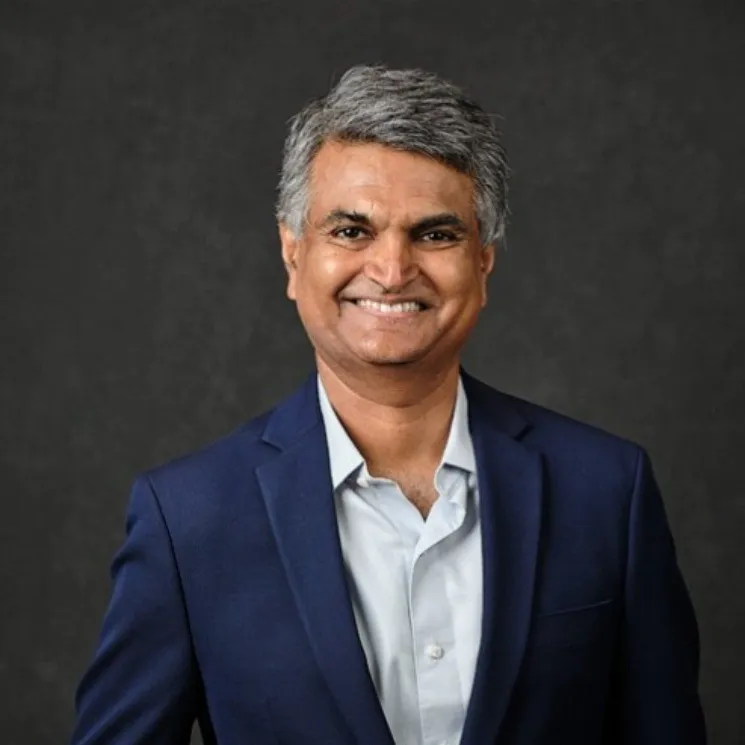
Nagaraja Srivatsan
Senior executive with over 30 years of experience driving digital transformation, AI, and analytics across global life sciences and healthcare. As CEO of endpoint Clinical, and former SVP & Chief Digital Officer at IQVIA R&D Solutions, Nagaraja champions data-driven modernization and eClinical innovation. He hosts the Life Sciences DNA podcast—exploring real-world AI applications in pharma—and previously launched strategic growth initiatives at EXL, Cognizant, and IQVIA. Recognized twice by PharmaVOICE as one of the “Top 100 Most Inspiring People” in life sciences
Our Speaker
.jpg)
Dr Bijoy Sagar
Bijoy Sagar is the Chief Digital & Information Officer at Bayer, where he leads enterprise-wide digital transformation, AI innovation, and data strategy across pharmaceuticals, consumer health, and crop sciences. With more than 30 years of experience spanning research, commercial operations, strategy, and technology, Bijoy is focused on helping organizations reimagine workflows, scale AI responsibly, and drive meaningful business outcomes through innovation.
Recent Episodes