De-Risking R&D with AI
In This Episode
In this episode of Life Sciences DNA, host Nagaraja Srivatsan speaks with Dr. Gabi Tarcic, Chief Product Officer at Evogene, a computational drug discovery company using AI to design new small-molecule therapies. Gabi shares how AI is augmenting researchers across the discovery workflow from literature review to experiment analysis to predictive modeling and what it really takes to bring AI into a highly expert, chemistry-driven environment.
- How small-molecule drug discovery works today and why it’s so resource and data intensive.
- AI as “augmented intelligence”: helping scientists search literature, analyze experiments, and interpret complex results.
- The step-change with generative and agentic AI in predicting outcomes and accelerating discovery cycles.
- Why domain expertise and scientific rigor are essential guardrails when using AI in research.
- The culture shift: multidisciplinary teams, change management, and using real results to win over skeptical researchers.
Transcript
Daniel Levine (00:00)
The Life Sciences DNA podcast is sponsored by Agilisium Labs, a collaborative space where Agilisium works with its clients to co-develop and incubate POCs, products, and solutions. To learn how Agilisium Labs can use the power of its generative AI for life sciences analytics, visit them at labs.agilisium.com. We've got Gabi Tarcic on the show today. Who's Gabi?
Nagaraja Srivatsan (00:29)
Gabi oversees product strategy and development for a company, Evogene, where he leverages the company's platform to drive innovation in the discovery and development of therapeutics, agricultural chemicals, and industry scale crops. He has more than a decade of executive and R &D leadership experience in the biotechnology sector. He holds a PhD in biology from the Weissman Institute of Science. I'm really excited to have Gabi on the show.
Daniel Levine (00:57)
And what is Evogene ?
Nagaraja Srivatsan (00:58)
Evogene is a computational biology company based in Israel that develops life sciences products using advanced AI and big data technologies. The company's proprietary platforms are used for the discovery and design of novel microbes, small molecules, and genetic elements with applications in pharmaceuticals, agricultural, and industrial fields.
Daniel Levine (01:21)
And what are you hoping to hear from Gabi today?
Nagaraja Srivatsan (01:24)
Danny, this is a very interesting field. The researcher in the drug discovery process is a PhD. He or she is really looking to drive innovation. So I want to talk to him about how you can leverage AI to make their jobs much better. How do you make the researchers more productive from a drug discovery standpoint? With that aspect, I want to explore what else one should be doing to further the adoption of AI in that field.
Daniel Levine (01:53)
Before we begin, I want to remind our audience that they can stay up on the latest episodes of Life Sciences DNA by hitting the subscribe button. If you enjoy the content, be sure to hit the like button and let us know your thoughts in the comments section. And don't forget to listen to us on the go by downloading an audio only version of the show from your preferred podcast platform. With that, let's welcome Gabi to the show.
Nagaraja Srivatsan (02:19)
Hi, Gabi. Welcome to the show. Really excited to have you here. Gabi, why don't you tell us about your journey and what you're doing currently, but also what got you to this particular place?
Gabi Tarcic (02:31)
Yeah, thanks, Sri. Thank you so much for having me here. It's a pleasure. Hopefully it's going to be fun, fun as well. My journey is actually kind of long. I've been doing most of my career in the field of drug research, drug and biological research, starting off with, you know, with my academic degrees, ending up with a PhD in the Weissman Institute of Life Sciences in Israel focused in on oncology. And then I've actually shifted gears towards a more of a startup mode, going into a company that has been funded based on the technology that back at the day we were aiming at really solving a problem of the right treatments for the right patients. This took a while to actually mature enough to become - to become an actual tool, but through those, through those years, we've actually also identified the fact that, this might actually be better off as a drug development tool rather than as a diagnostic tool. And in that sense, we kind of pivoted into actual drug development and we're fortunate enough to be able to move a drug into the clinic through clinical trials and, and, you know, seeing that mature - kind of seeing that process and being able to really affect people's lives through our work was just breathtaking. And, given those aspects, you know, I said, well, this is something that can, can, can really make a change and really drives me and motivates me. And that's how I ended up my current role at Evogene, which is a drug, the computational drug discovery company where we are utilizing AI based tools for small molecule drug development. So really, you know, doing the discovery of new therapies. It's been a long journey.
Nagaraja Srivatsan (04:20)
Yeah. Yeah, it's a very good part. So, tell me, before we talk about the impact of AI, what is the current situation in small molecule drug discovery? How does the process work? Who works on it? How long does it take? What are some of the key challenges?
Gabi Tarcic (04:41)
It's a big question and it's something that's been in the works for decades now, right? Drug development is something that's been already established way, way back. And small molecules don't differ than any other type of drug that is developed. Where the average time to bring a new drug to the market to patients is about 15 years, right? It's a very, very long process that starts with research, with basic understanding of disease mechanisms, of how different mechanisms, different diseases are being either developed or inhibited by potential new therapies, then designing the right therapies for those targets that have been identified and making sure that they're safe, that they're actually doing what they're supposed to do. And all of this is even before going into actual patients, right? Even into actual clinical trials. Only then the really hard-beat, hard part starts with clinical trials, which is a very lengthy, very well-controlled and regulated process that essentially is there to make sure that first of all, the drug is actually bringing true benefit to the patients, but secondly that it's not causing any additional harm. You know, taking all that into account 15 years is actually a reasonable timeframe. Small molecules in that sense have been around for decades, since the 80s and 90s of the last century. And right now, we are seeing actually a boom or a...an interest, regained interest in this field because it just offers so many opportunities given that chemistry is a huge playing field, I like to call it. So, it's just something that we are seeing up and coming again.
Nagaraja Srivatsan (06:41)
No, that's fantastic. And then you said there's the discovery side, which takes a long time. And then once you find the molecule, then it goes into the patient. And then that takes between 12 to 15 years, typically, across the board. Let's focus on the discovery, because that's kind of where you've done a lot of your research, as well as what this company is doing. So in the discovery spot, you have several different, as you said, drug targets, and then several mechanisms of action, and several combinations which you're working to make sure that you have the right drug for the right kind of problem statement. It's pretty data intensive and pretty human workforce intensive. Tell me a little bit about what does that feel look like and then how AI can make a big difference because of the human intensive nature and data intensive nature of that particular problem.
Gabi Tarcic (07:36)
There are several steps to this process and throughout there are multiple aspects that are both resource intensive, mostly researchers and actually doing experiments in a lab to make sure that hypotheses are correct. But also, there's a lot of data that needs to be taken into account when doing these experiments because we are dealing with very complex systems, biology in general, the human body specifically is an extremely complex system. And in that respect, the ability and the requirement actually to perform multiple experiments, to gain as many results as possible to establish or to refute the specific hypothesis in mind is critical. Historically, this has been done with very well established scientific methods of, you know, hypothesis driven experimentation and the ability to establish actually through results to make sure that, you know, you're still on track. But more and more, what we are seeing is that computational tools are being exploited to first of all, de-risk a lot of these processes, inform them, but very importantly also...interpret them very accurately to make sure that as much data as possible is extracted from these experiments. And AI is the latest in this process, but this has been going on for years now when many different computational tools have been incorporated into our workflows, each one bringing more benefit, right? What we are seeing is that this is actually an industry that's ever changing, always trying to adapt new tools and making sure that given the nature of the goal that we have in mind, make sure that we are doing the best and the most to improve our processes and to make sure that they're successful.
Nagaraja Srivatsan (09:28)
Yeah. Now you hit upon a good thing, right? So, AI is not by itself, but it is helping improve the current processes and the researchers' productivity. So, it's an augmented intelligence rather than artificial intelligence. But tell me, are some of the augmentations a tool like this can do vis-a-vis for a discovery research scientist? What is a day in the life of a research scientist and what are the augmentation capabilities available for them through AI?
Gabi Tarcic (09:57)
Yeah. And I think it touches the entire gamut of capabilities that's required for a researcher. B, basic understanding of a problem, which for that you need to screen through a lot of literature, make sure that you're not missing any type of publications, for example, or any other thing that might impact or affect your experimentation. And you know, that's where, the more common LLMs coming to play, ChatGPT and all of the others just allowing us to screen, summarize huge amounts of data very efficiently. I think on the experimentation side itself, there's a lot of analysis tools, either image analysis based, sequence based, and others that are used to interpret a lot of results together and kind of summarize them and make sure that they kind of form a coherent picture of what the data is actually telling you. And I think, and this is where it gets really interesting, there's also the predictive tools, the computational tools that allow you to predict what an outcome would look like. And this is where it gets really interesting because that's also where generative AI can become instrumental, where you have more of the complex tools that require a lot of computing power itself are used to predict these types of outcomes. And then of course, you know, also make sure that they're validated.
Nagaraja Srivatsan (11:23)
See, you hit upon a good part, right? AI has always been in the marketplace for a long time. Classic AI, machine learning, prediction algorithms, finding things out. What are you seeing? Has there been a step change now with generative AI coming in to help through the research of problems? Because discovery always used AI tools for a lot of the heavy lifting. But are you seeing quite a bit of acceleration? Or is that a new normal being set up?
Gabi Tarcic (11:48)
Definitely. think the standards have changed, right? The possibilities that have been opened by these new tools are just too good not to take advantage of. And in that sense, generative AI and more so, and that's kind of where things are probably going, agentic AI are the type of tools that really empower the scientists to get at much, much better results and much quicker progress in, in, what they're doing. And we are seeing this already happening, right? This is already showing us that we can just do better and quicker.
Nagaraja Srivatsan (12:28)
So, there's great promise in the tools. As with every tool, there's the pros and the cons. So tell me about it. What are some of the typical challenges somebody faces when you're starting to adopt these tools? What do you need to do for a researcher to be prepared to use these tools? What kind of guardrails do you have to put in place to make sure things are progressing well?
Gabi Tarcic (12:50)
The basic premise is to look at these, as you mentioned, tools and not taking over your actual work. They are tools that are there to help us progress and move forward, but they're not here to replace us because you always need to keep that criticism in mind. You always need to make sure that whatever outputs are, and whatever outputs you're receiving are actually vetted and critically evaluated to make sure that they're not just taking you off course, or they're just completely misinterpreting what you're seeing. And that requires expertise and knowledge. That requires the user to be well versed in the subject matter so that you're not just derailed by these types of results.
Nagaraja Srivatsan (13:39)
So, you said that the user has to be competent, user has to be expert in what they're doing while familiar with working through these tools. Walk me through what is the change management? A researcher is so used to writing it in a lab notebook or an electronic lab notebook, which is the way they do it. They do bench experiments. They have these beautiful documentation of their life, but each documentation is different from each other. Now you come and say, I'm going to give you a tool to change your life. What is the change management for these guys? What is the pathway to make them adopt this kind of radical change?
Gabi Tarcic (14:13)
It's not an easy task, right? Because there's a lot of conservative approaches when we do drug development. And this comes, as I said in beginning, because it's historically a very long process, but it's also something that's been very well established - we have our methods, so to speak. On the other side, when you're exposed to the vast potential that these types of tools open for us, sometimes it's just too clear a picture to ignore. And in that sense, I think just showcasing the capabilities, explaining and showing how much better your work can be performed using these new tools is the best way forward. I'm less connected to those aspects at the moment because I'm doing more of computational work. But when we were doing that before, I think that was showing that it's not extra work. It's actually doing the work for you in many, in many senses is a game changer.
Nagaraja Srivatsan (15:19)
Sure. So, let's shift to a little bit more of computational work that you're doing. You have lots of tools now available. As you said, the LLMs are evolving. The GPT models are. Is there specific things which are better for computational powers? Hey, we should use Open AI because that's better than Claude or Claude is better than DeepSeq. Are there specific tool sets which are best suited for the competition area?
Gabi Tarcic (15:46)
Each one has their own favorites and it's many times very task specific. So, you can use, as you mentioned, OpenAI and that's more effective for certain tasks than others. But at the base of it, most of the tools at the end of the day for us, are effective and it's really a matter of many times, of what specific individual preferences you might have. When you think about it in the more complex scenarios of doing heavy lifting, but also doing it cloud-based computing and things like that, then it's like, can get more complicated because you need to incorporate that type of interfaces and the ability to work on a cloud-based platform and that can change things a bit. But at the end of the day, there are so many tools out there that are doing such a wonderful, such a great job that it's not a matter of a knockout, so to speak, that one is objectively better than the others.
Nagaraja Srivatsan (16:48)
Yeah. So, as you're starting to build a product, which is solving a particular industry problem. You have a choice whether to be a maker, that is make your own LLMs or AI tools, or shaper, take and shape it, or be a taker, take what is available and then just deploy it in your workflow. Where are you in this journey? And if so, how do you go about making a decision whether you're a maker, a shaper or a taker in this continuum?
Gabi Tarcic (17:18)
So, the way we look at it, at least at Evogene where I'm doing this AI work right now, is that it really depends on the task at hand. We prefer to be makers because we have in-house algorithmic teams that are able to actually develop those tools from scratch. But these are the tasks that we usually do for the unique questions and the unique aspects that we need to develop. Sometimes...there's just great options available. And then there's no reason to start from scratch. You can just build upon those types of tools and integrate them into your workflow. But what we see is that we need that ability to make our own tools as well, because that's our unique value proposition that was differentiating us from others and allows us to actually achieve our goals much more effectively.
Nagaraja Srivatsan (18:07)
Is it a cost issue? Because if you're a maker, then you have huge GPU costs and compute costs to doing it. Whereas if you shape it, you're more algorithmic and you're not doing the learning model, but you're only shaping it. How do you go about the pros and cons and which way you should be going for?
Gabi Tarcic (18:27)
There's definitely, and that's ⁓ a major driver of our decisions, which is the cost benefit. At the end of the day, if it's something that's central enough to our work and it's something that's critical enough for us to focus on, that kind of shifts the balance between the cost and...and the benefit and we are going to do it anyhow in just a matter of how to do it most efficiently. On the other hand, if it's more of kind of the standard tasks, things that might be more of an off the shelf solutions, then yeah, there's no reason to put too much, least from a cost perspective, too much into it. And it's better just to optimize our cost structure for those specific tasks. At the end of the day, what we see is that if you really want to make progress in these fields, then it's going to require these types of investments.
Nagaraja Srivatsan (19:30)
And as you were starting to build these things out, tell me a little bit about the culture of your team. Are these guys all AI guys? They're all chemistry analysts? How do you bring in that ⁓ technology to the right business problem? How are you bringing that right mix within your teams?
Gabi Tarcic (19:47)
It's a very multidisciplinary approach that we have. We have computational chemists and these are the ones that are actually able to identify the problems, articulate them correctly and try and start forming the answers. Similarly, we also have algorithm developers that are very well experienced and very well versed in the AI field. And these are the people that are actually doing the coding itself. And similarly, specifically for a project we had a while back when we were doing a novel foundation model, we also had a collaboration with the Google Cloud team, which brought their knowledge on infrastructure and the use of their tools. So it's really bringing everybody together for a common goal, that's I think the important aspect here.
Nagaraja Srivatsan (20:40)
So, let's explore computational chemists, which you have very solid domain people who understand chemistry and everything to do with chemistry. How do you get that team, which is your classic research, to be working in the same language as the AI guys? Or do you see these guys are talking chemistry, these guys are talking AI, you need somewhere to bridge in the middle. What is the dynamics you're seeing between the teams there?
Gabi Tarcic (21:04)
So, I think we're fortunate to have the AI people also be chemists in training and their basic training. They really know the language; they know how to express themselves correctly. And it's a very different approach when you're doing, for example, computational chemistry than when you're doing LLM, classical LLMs or image analysis or any other type of AI driven approach. So, for us, it was very important to be able to bring those types of people in-house and have them work hand in hand, because at the end of the day, the scientific rigor here is immense. You know, the chemistry problems are the types of problems we're trying to solve. So, we need to understand those problems very, very well in order to make sure that we're actually solving them, and as I said, able to criticize our results.
Nagaraja Srivatsan (21:55)
So, as you bring a product to market, you're always going to be facing other chemists and other researchers to adopt this project. Again, just exploring that, is that a big change where you're showing them before and after with your platform or are there like three big problems they need to solve and you pre-solve them for it? How do you engage in a conversation or change where people are so used to doing it in the same way?
Gabi Tarcic (22:20)
This is an open discussion that we always need to keep kind of actively going on. And one of the key things is that results at the end of the day matter. And we were able to show what we were doing and show the results coming out of the system and that, you know, the validations of those types of results are actually proving that it works. I think that's taking out a lot of the concern and reducing a lot of the kind of skepticism around what we do. Because at the end of the day, what people are interested in and what researchers want is progress and showing that they're able to move forward in their research. And once you are able to show that through our results, I think that's a game changer.
Nagaraja Srivatsan (23:10)
Just as bringing AI into any pharma company has lots of regulatory issues, a lot of change, what are the top objections you hear from your customers? Hey, it's a cloud-based platform, my data is going away, or you're learning in my algorithm, or I'm just making it up, but what would be, in your opinion, top objections? Naturally, let's say the chemist, you already have talked their language and as you said, are result-oriented in solving it. And you face issues from the chief privacy officer, do you face issues from chief data officer, chief security officer? What are some of the challenges you have to go over for an adoption of a tool like this?
Gabi Tarcic (23:54)
It's actually everything you said, but much more. All of these privacy issues, data management issues and IP issues, which is essentially what you said, you're learning from my examples, are kind of key to the type of discussions that we're having and need to be, I don't know if resolved, but at least acknowledged enough before you go into specific project or any type of collaboration. On top of that, you also have a lot of questions around how can you do it if I'm failing? So how are you solving it that's different from what I'm doing? And as many times these types of discussions tend to become very scientific. And for that, we are bringing our own scientific people to have those discussions. But to be honest, usually if our partner has a specific problem and we are able to show that we can solve it and either reduce the time it takes to develop a drug or reduce the costs or I think most importantly, make sure that you increase the probability of success along the process, then it takes over the entire discussion and it makes the other aspects secondary to the decision.
Nagaraja Srivatsan (25:21)
Gabi, it's a chicken and egg, right? Hey, of course, you proved probability of success. They're going to love you and take you, but how do you get them to test you before you get to a probability of success? Is there a specific archetypes that people who are more innovators go down this path or people who are very stuck in a business problem come to this or somebody is like, my God, this AI journey is going to pass me by, so let me try it out. What is your typical profile for the experiment?
Gabi Tarcic (25:51)
Your comment about many people making sure that they're not missing the train is critical because they're seeing that shift and they're seeing the kind of effects that AI-driven tools are having on our ecosystem and on our industry, and they want to make sure that they're not missing anything. So that's definitely something that's in their minds. And it's rightfully so. Different companies have different risk profiles. And the earlier stage companies are much more, their appetite for risk is higher because they want to kind of establish themselves, whereas bigger companies are probably or usually more risk averse and they're trying to see much more data and make sure that their decisions are much, much better informed. So, it's a very different type of story. But having said that, we're seeing AI driven tools in all aspects of what we're doing, both on a day to day basis, as well as on more, you know, global research initiatives. And it's just something that's here to stay, so to speak. So, they can't pass it on essentially.
Nagaraja Srivatsan (27:04)
So, tell me, you said the last two, three years have dramatically shifted. What tools are available? What outputs and results are happening? Is that all LLM shift? Is there other things which are going on in this space? What are you seeing it improve and what kind of productivity improvements are we talking about from a researcher standpoint?
Gabi Tarcic (27:25)
It affects all levels of activity. LLMs of course, which are kind of more day-to-day use. Our ability even to articulate ourselves better using an LLM is just something that saves a lot of time, right? You need to write something very complex and you make sure you're not missing anything just through passing it via one of those engines. I think it's also something that's been incorporated more and more in the complex activities of research. And then it's not only the LLM, it's image-based tools, chemistry-focused tools, and many others that are really showing us how much more we can gain from what we do. Once you see that, you're understanding that it's just something that is incorporated throughout our work.
Nagaraja Srivatsan (28:16)
Yeah. So, it's been fascinating. You're solving a very specific domain problem. You brought together two sets of diverse people, the AI people and the chemists, making them talk in a similar language, then applying multiple different workflow interventions to make sure that you can improve probability of success and other metrics. Just as a person who is running many of this organization. So, what does good look like for you? Is it more people adopting the platform, more molecules coming up into the market? How do you evaluate success of a platform like yours?
Gabi Tarcic (28:53)
For us specifically, what we do, outcomes are pretty straightforward - is that if we're able to design a novel drug that essentially is hitting a target, doing what it's supposed to do and making it all the way through to approval, then you know that's success. The problem is that it takes years to show that. So, it's a very long process. But more specifically, for what we do and if we're able to, for example, and we have very clear KPIs for the different applications that we have. And if we're able to show that we meet the KPIs that, for example, we have good inhibition profiles for the candidates that we're developing, that they're meeting the specific criteria that are required to meet, that's essentially showing that it's successful, right? It's a very lengthy process, as I said, but we are able to kind of make sure along the way that we're not off track too much.
Nagaraja Srivatsan (29:54)
Yeah. Now Gabi, this has been a fascinating discussion. Any key takeaways you want to share with the audience around that AI journey? So typically, people who are tuning into our podcast are down the AI journey and they want to know what are the gotchas, what should they avoid so that they can start to go from pilot to scale. Any thoughts on how they should be progressing in their journey?
Gabi Tarcic (30:19)
And it's only for my specific individual perspective. I'm not a technology person, right? I'm coming from the scientific side. I'm a biologist by training. And I came to this AI story because I saw that this is a very powerful tool to solve the problems that I'm trying to solve. And when you look at it that way, when you think about the AI as an enabler rather than the purpose itself, I think it makes it much more effective. It allows you to adapt to the technology and make sure that you're using the right tools to solve the problem. And always keeping that kind of focus on what you're trying to solve is critical. Hand in hand, you need to be very flexible in the tools you're using and in the problems you're trying to solve, because problems might change along the way. It's research, right? So, you never know. But I think that if you look at AI not as the goal itself. There's some people, and I'm not saying I'm one of them, which are devoted to developing really basic AI-based tool. I think most of us are not those types of people. And therefore, being able to make sure that you're doing - that you're adopting AI tools for the right solution is critical.
Nagaraja Srivatsan (31:34)
I think that's spot on - not having AI like a hammer chasing a nail, but having a very well-defined problem statement and then how do you use that. It has been a fascinating discussion in and around all of the different things. As you said, as a biologist, as a researcher, they're facing several problems in terms of whether it's curation of documents to connecting experiments to summarizing what's the results to hypothesis testing to prediction. And so, there's several things to be applied within the AI discovery side to figure out what would be a next drug to market. And you're playing a very important part and role in that journey. So, thank you. Thank you for your insights. Thank you for what you're doing in the marketplace. And thank you specifically to the patients who can benefit from those drug opportunities which are generated from your platform.
Gabi Tarcic (32:29)
Thank you very much, it's been a pleasure. Thank you.
Daniel Levine (32:33)
Well, Sri, what did you think?
Nagaraja Srivatsan (32:35)
I think it was a great conversation. Whenever you're trying to build tools to a very domain heavy, expertise heavy marketplace, it's very important to be very thoughtful and measured. And I thought he had a very good discussion on how do you bring technology and tools to the researchers.
Daniel Levine (32:53)
You asked about the benefits the tools were bringing and there's obviously an opportunity to accelerate processes and offload a lot of duplicative work, but he talked about predictive tools being where it's getting interesting. How do you see the predictive capabilities changing how AI is used and the benefits it can provide?
Nagaraja Srivatsan (33:14)
Actually, I'll take a step back, Danny. He talked about three best use cases what researchers do from an AI perspective, right? The first is understanding the problem, any problem they're trying to solve. That's literature search, looking at lots of volumes of data and then bringing that together. The second is experimentation, where you're experimenting with these different mechanisms of action and different chemical entities to figure out what needs to be done. The third is based on these two, the prediction on which drugs would be most suited for which therapeutic pathways and how would you go about solving this problem. So, we did explore a little bit about the predictive capabilities, but that's based on the foundation of good understanding of chemistry, good understanding of biology and science, and good understanding of these mechanism of actions to make sure that we are having the right target for the right problem.
Daniel Levine (34:08)
You asked about the pathway to adoption and Gabi said it isn't easy because of conservative and well-established approaches, but he expressed the kind of faith in the power of the technology to change minds. Is that the experience you've seen?
Nagaraja Srivatsan (34:25)
This particular marketplace is really very much about expertise and experience. These folks are very suited in the areas where they have been for a long, long time. So, these guys are PhDs, experts. When you bring in AI, it's change management. They really look at, what do I need to do to change myself? What he talked about, which was very interesting, is you show change by showing results. So, some people are very skeptical about the tool. He said that many of them are actually very interested because of fear of missing out, FOMO. If they fear missing out, then they start to explore, what can this tool do for me? And that's when a results-oriented, data-oriented problem solving oriented approach would lead to adoption. So, I think it was a very fascinating way of really looking at the persona and then really looking at how do you then change the persona to adopt newer technologies.
Daniel Levine (35:29)
Well, it was interesting to hear him talk about the fear of missing out. To what extent is this industry seeing AI as an essential to being competitive, that it's no longer a nice to have, but a must have?
Nagaraja Srivatsan (35:42)
Danny, there are several AI discovery companies. These companies are applying tools and technologies to actually discover a molecule, but go further and actually doing clinical research. So, this marketplace is changing. This is because the target identification, if you start from a hundred targets, the traditional models get you to maybe 45 or 40 targets, and then you have to conduct wet lab experiments, and then after that you have to go and actually conduct clinical research, and you may be taking 20 molecules to market. Now with AI discovery, you could take that 100 and predict which of the 20 would be much more effective, and when you conduct clinical trials, they are much sharper, and maybe you are only taking five to the market. He talked about probability of success. That's the probability of success. If you can predict that, those which are coming through this mechanism has higher probability of success to be developed clinically well in patient populations, then you have a huge win because you're cutting away a lot of wasted experiments.
Daniel Levine (36:48)
Well, it was an interesting conversation and enjoyed it as always, Sri. Thanks so much for your time.
Nagaraja Srivatsan (36:55)
Thank you so much, Danny. Cheers.
Daniel Levine (36:57)
Thanks again to our sponsor, Agilisium Labs. Life Sciences DNA is a bi-monthly podcast produced by the Levine Media Group with production support from Fullview Media. Be sure to follow us on your preferred podcast platform. Music for this podcast is provided courtesy of the Jonah Levine Collective. We'd love to hear from you. Pop us a note at danny@levinemediagroup.com.
For Life Sciences DNA, I'm Daniel Levine. Thanks for joining us.
Our Host

Nagaraja Srivatsan
Senior executive with over 30 years of experience driving digital transformation, AI, and analytics across global life sciences and healthcare. As CEO of endpoint Clinical, and former SVP & Chief Digital Officer at IQVIA R&D Solutions, Nagaraja champions data-driven modernization and eClinical innovation. He hosts the Life Sciences DNA podcast—exploring real-world AI applications in pharma—and previously launched strategic growth initiatives at EXL, Cognizant, and IQVIA. Recognized twice by PharmaVOICE as one of the “Top 100 Most Inspiring People” in life sciences
Our Speaker
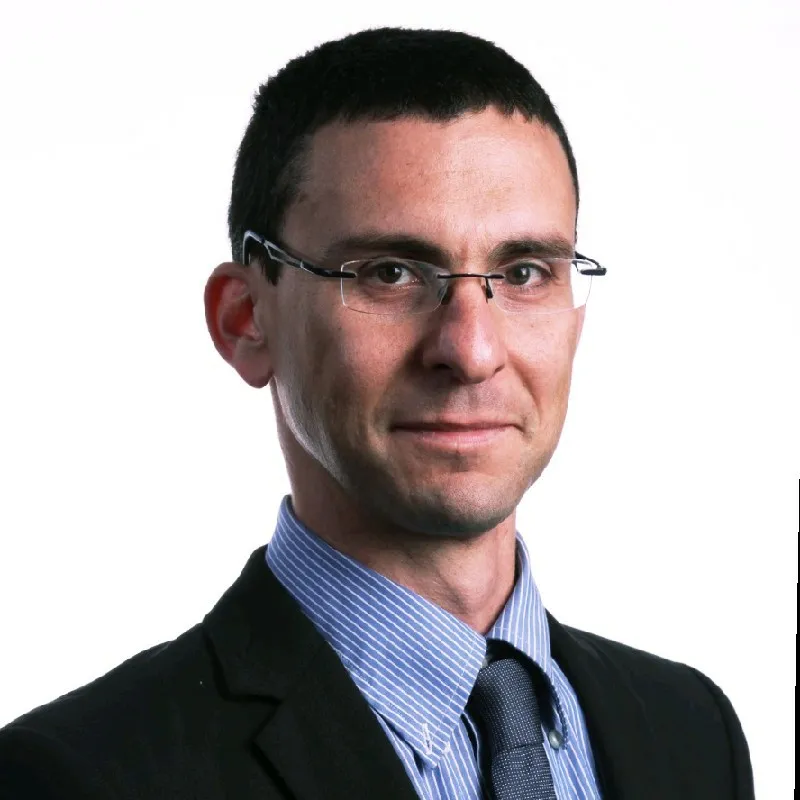
Dr. Gabi Tarcic
Dr Gabi Tarcic holds a PhD in Biology from the Weizmann Institute of Science. An experienced biotechnology leader, he has spent more than a decade advancing translational research, product innovation, and strategic decision making across the life sciences. As vice president of product at Evogene, he brings deep expertise in molecular and cellular biology and a strong record of guiding scientific and technical teams to drive meaningful healthcare solutions.
Recent Episodes
.jpg)